

2.1 Education vision and principles
Education is fundamental to the development of individuals, families and communities. A quality education is the foundation for a stronger and more resilient Victoria, in which everyone has the skills and knowledge they need to actively participate in and contribute to our rapidly changing economy and society.
The Department of Education (DE) leads the delivery of education and development services to children, young people and adults in Victoria. It does this directly through government schools and indirectly through the regulation and funding of early learning services, non-government schools and training programs.
DE’s Statement of Strategic Intent supports this mission:
A great education for every child and young person – so they can thrive now, and into the future, and contribute to a fairer, smarter, and more prosperous state.
2.1.1 Victorian public sector values
In pursuing the above mission and intent, DE is committed to upholding the Victorian public sector values in every aspect of its work, as follows:
| VPS value | Value description |
|---|---|
| Responsiveness | We respond in a timely way with our best work |
| Integrity | We are honest, ethical and transparent |
| Impartiality | We behave in the best interests of the public by making fair and objective decisions |
| Accountability | We hold ourselves and others to account for the work that we do |
| Respect | We value others and accept their differences |
| Leadership | We are genuine, supportive and do the right thing |
| Human rights | We uphold and respect the rights of others |
All those involved in the execution of DE’s mission and intent – including colleagues and stakeholders – must uphold these values, and consider how the values can contribute to the completion of their task.
2.1.2 Outcome areas
DE uses rigorous processes to gauge the effect of its work on Victorians, and can readily identify progress and areas for improvement. DE has identified four key outcome areas under which it strives for excellence, in all projects and investments:
| DE outcome areas | Outcome area descriptions |
|---|---|
| Achievement | Raise standards of learning and development achieved by Victorians using education, training, development and child health services |
| Engagement | Increase the number of Victorians actively participating in education, training, development and child health services |
| Wellbeing | Increase the contribution education, training, development and child health services make to good health and quality of life for all Victorians, particularly children and young people |
| Productivity | Increase the productivity of our services |
2.2 School education principles
Schools are required to create a positive climate for learning and wellbeing, generate a culture of high expectations and promote inclusion. DE is committed to providing education and support to all students, and will promote leading practices in the design of education facilities.
Project consultants must design and develop buildings that will support the achievement of the vision and values identified above. To assist in this task, four education principles have been identified that capture DE's vision and values.
The purpose of these principles is to ensure, as much as possible, the design of educational environments that are usable by everyone, without adaptation or specialised design.
Each of the four education principles has specific implications for the design of facilities at Victorian government schools. They are to be applied to all Victorian government school capital projects, including new and greenfield developments, new buildings in established areas, and upgrades to existing school infrastructure.
The four Education Principles are identified in Figure 1.
Figure 1: Education principles

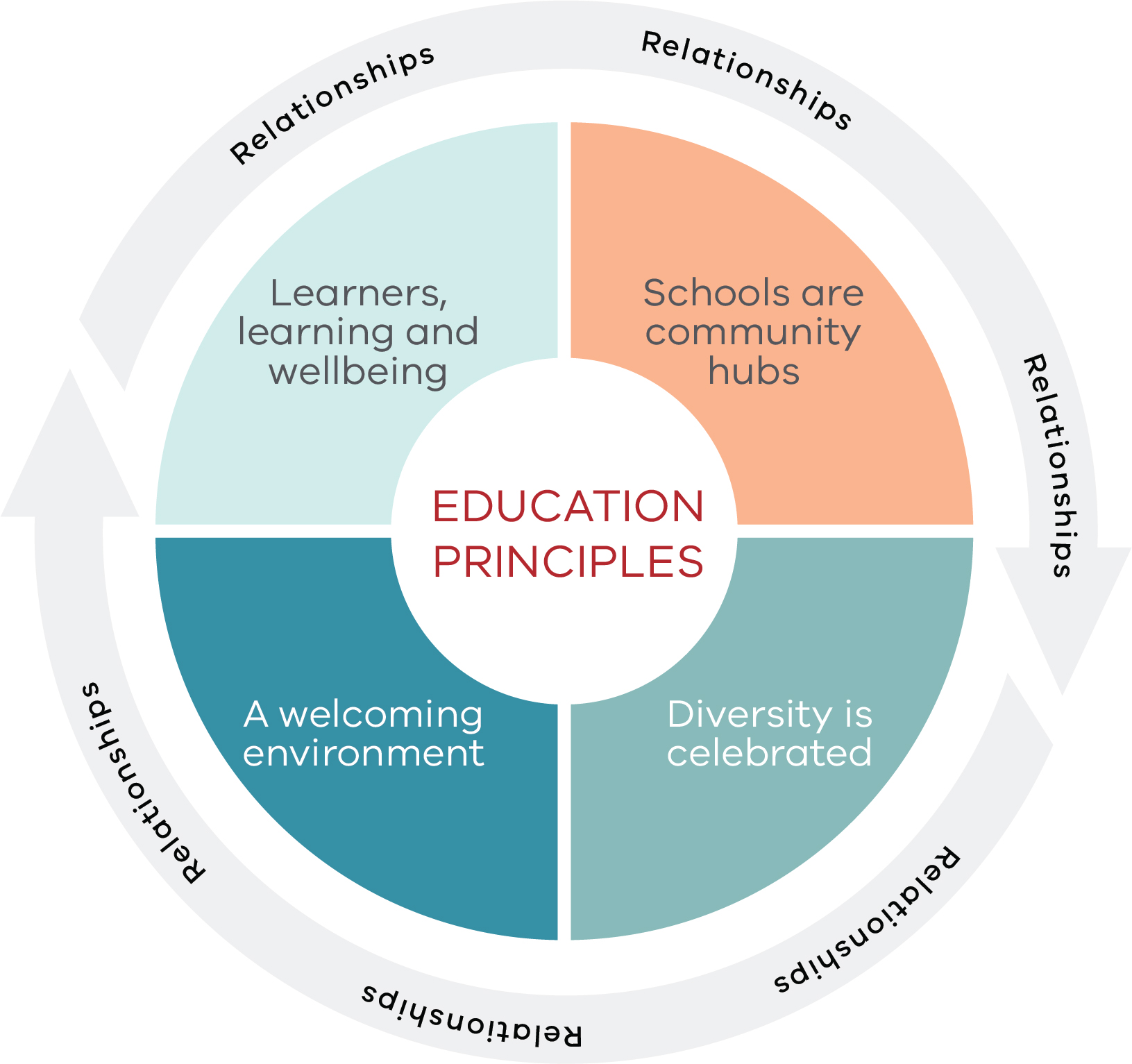
Underpinning these 4 design principles is the need to establish and enhance ‘Relationships’, both within the school and the wider community. This approach follows the VSBA’s policy of non-standardised design of Victorian government schools, which encourages innovation and school infrastructure to reflect the local context and each school’s educational rationale, community requirements and site-specific conditions.
High quality environments promote children's wellbeing and engagement, positive learning experiences and inclusive relationships. Physical learning environments must include both indoor and outdoor learning spaces that satisfy the key principles, including NQF indoor and outdoor requirements, such as:
- flexibility and accessibility
- a range of developmentally appropriate, open ended activities and sensory experiences
- an environment that is sustainable, fit for purpose and reflects the diversity of families within the local and broader community.
2.2.1 Learners, learning and wellbeing
Learners, learning and wellbeing are the core foci for all schools. School design should be centred on providing environments that enable educators and other support staff to support the development of young people – intellectually, emotionally, socially, physically and culturally. Relationships are also central to wellbeing and learning for both staff and students. Project consultants applying this principle should consider whether their work:
- promotes a learners and learning-centred approach to develop personal agency and empowerment
- helps students develop confidence as learners through active investigation, inquiry, social interaction and collaboration
- inspires creativity, curiosity, curation and critique
- encourages the development of a sense of identity
- develops critical and creative thinking, personal and social capability, ethical understanding and intercultural understanding
- enables learning anywhere, anytime, with anyone, by any means, through harnessing digital technologies
- provides opportunities and makes facilities available for community learning.
2.2.2 Schools are community hubs
Integrated facilities such gymnasiums, performing arts centres, health service consulting rooms, and libraries can foster greater community engagement and wellbeing and help schools develop partnerships with people, organisations and local services.
Project consultants applying this principle should aim to:
- promote a sense of community and belonging by promoting human connectedness
- encourage participation and engagement
- develop partnerships and foster networks of partners to break down barriers
- build community by encouraging participation, contribution and engagement in and by the community, at all levels
- express the identity, values and aspirations of the community.
2.2.3 Diversity is celebrated
Inclusive schools recognise and respond to the diverse needs of their students, including students with disability, from culturally and linguistically diverse backgrounds, international students, and LGBTIQ+ students. They accommodate different styles and rates of learning. School and early learning facility design should respect, welcome and celebrate diversity and provide culturally safe environments for First Nations students, children and staff. Designs should support staff to work collaboratively and provide every student and child with the individualised learning and wellbeing support they need to thrive. Project consultants applying this principle should aim to:
- ensure all learners will be included
- provide genuine choice for all learners.
Refer to sections 3.2 Universal design and 3.1.2 Recognition of First Nations culture in new facilities and major upgrades for more information.
2.2.4 A welcoming environment
Schools should be welcoming, safe, secure and stimulating environments. The entry of a school should distinguish it as a learning and wellbeing community, with accessible pathways and signage to help everyone feel welcome.
Project consultants applying this principle should aim to:
- promote positive social interaction
- ensure safety and security
- create aesthetically pleasing facilities
- provide a continuum of learning and recreation
- develop both the learners’ understanding of personal wellbeing, and their capacity to create personal wellbeing.
2.2.5 Early learning education matters
The Department of Education is delivering new early learning facilities to provide additional infrastructure capacity to support the roll-out of Three and Four Year Old Kindergarten and the Best Start, Best Life program across Victoria. High quality learning is supported through the physical and social environments, and opportunities that these early learning facilities provide.
The Victorian Early Years Learning and Development Framework (VEYLDF) adopts a comprehensive approach to children’s learning and development. The VEYLDF sets out outcomes and practices to guide early learning professionals in their work with all families and their young children from birth. Supporting children to progress toward these outcomes in conjunction with their families is the core of the VEYLDF.
Early learning facility design must be designed to support the VEYLDF’s 9 practice principles.
2.3 Overview of school curriculum and pedagogy requirements
Student learning is shaped and influenced by both curriculum and pedagogy. A curriculum defines what it is that students should learn, and the associated progression or continuum of learning. Complementing this, pedagogy describes the method and practice of how students will be taught and supported to learn.
This section provides insight to the core business of Victorian government schools. Project consultants should be aware of the latest Victorian curriculum, along with the teaching and learning methods practiced at the relevant school.
2.3.1 The Victorian school curriculum
The Victorian school curriculum sets out what all students learn in their schooling, as well as a supporting series of learning progressions to facilitate that learning. The Victorian Curriculum and Assessment Authority (VCAA) sets the Victorian school curriculum.
Project consultants must consider the range of subjects in the curriculum and the specialist facilities and equipment required.
Victorian curriculum F–10
The Victorian Curriculum F–10 sets out the knowledge, skills and attributes every student should learn during their first 11 years of schooling to become lifelong learners, confident individuals, active and informed citizens, and to make a successful transition from school to work, training or further education.
The learning areas and capabilities of the Victorian curriculum F–10 are set out below in Table 1.
| Learning areas | Capabilities |
|---|---|
The Arts
|
|
English and EAL Health and Physical Education The Humanities
Languages Mathematics Science Technologies
|
|
Senior secondary programs
For students in Years 11 and 12, two types of senior secondary certificates may be pursued at schools:
- the Victorian Certificate of Education (VCE), and
- students can also undertake a Vocational Education Training (VET) program, for which they can receive credit towards the VCE.
Victorian Certificate of Education
The VCE is undertaken by students in Years 11 and 12, but can be started in Year 10. VCE is the certificate that the majority of students in Victoria receive on satisfactory completion of their secondary education. It provides a range of subjects to meet the needs of students. It provides pathways to further study at university or TAFE, or to employment.
There are about 90 VCE studies courses available across the Arts, Business Studies, English, Health and Physical Education, Humanities, Languages, Mathematics, Science, and Technology, as well as the extended investigation that is an independent research project.
The VCE Vocational Major (VM) is a vocational and applied learning program within the VCE designed to be completed over a minimum of two years. The VCE VM will give students greater choice and flexibility to pursue their strengths and interests and develop the skills and capabilities needed to succeed in further education, work and life.
It prepares students to move into apprenticeships, traineeships, further education and training, university (via non-ATAR pathways) or directly into the workforce.
The VCE Vocational Major has four main studies:
- VCE VM literacy
- VCE VM Numeracy
- VCE VM Personal and Development Skills
- VCE VM Work-Related Skills
Students should also complete 180 nominal hours of a VET program.
More information can be found at About the VCE Vocational Major on the VCAA website.
Victorian Pathways Certificate
The Victorian Pathways Certificate (VPC) is a Year 11 and 12 standards-based certificate that meets the needs of a smaller number of students who are not able or ready to complete the VCE (including the VCE Vocational Major). It provides an enriched curriculum and excellent support for students to develop the skills, capabilities and qualities for success in personal and civic life.
The VPC has four main studies:
- VPC Literacy
- VPC Numeracy
- VPC Work Related Skills
- VPC Personal Development Skills
More information can be found at About the VPC on the VCAA website.
2.3.2 School pedagogy requirements
While the content of the curriculum is mandated by the VCAA, how curriculum is taught is a matter for individual schools. Schools have flexibility in the design of their teaching and learning program. This enables schools to develop specialisations, and areas of expertise and innovation, while ensuring the mandated curriculum is delivered.
School teachers, as facilitators of learning, can apply a range of pedagogies according to subject matter to target improvements in student skills and competencies. Examples of pedagogical approaches include project-based learning, research-based learning, self-directed learning, team collaboration, constructivist learning and discipline speciality.
DE has identified pedagogical principles that have been used throughout Victorian government schools. The principles state that students learn best when:
- the learning environment is supportive and productive
- the learning environment promotes independence, interdependence and self-motivation
- students’ needs, backgrounds, perspectives and interests are reflected in the learning program
- students are challenged and supported to develop deep levels of thinking and application
- assessment practices are an integral part of teaching and learning
- learning connects strongly with communities and practice beyond the school.
Linking learning and teaching principles to pedagogy and building design
Pedagogical activities require specific spatial qualities to be effective. New spaces must be adaptable and support a variety of teaching and learning approaches, from ‘team teaching’ to one-on-one lessons, and encourage collaboration between students and teachers.
Table 2 illustrates the links between principles, approaches and activities undertaken by students, and their implications for school building design.
The principles, approach and design implications outlined in the following table apply to all pedagogical activities, namely: Delivery, Applying, Creating, Communicating, and Decision making.
| Pedagogical principle | Pedagogical approach | Implications for school design |
|---|---|---|
| The learning environment is supportive and productive | Learner-centred pedagogies with multiple learning settings integrated |
|
| The learning environment promotes independence, interdependence and self-motivation | Peer-to-peer learning, integrated problem learning and resource-based learning |
|
| Students’ needs, backgrounds, perspectives and interests are reflected in the learning program | Theory linked to practice, resources used continually and creatively, and integrated curriculum delivery |
|
| Students are challenged and supported to develop deep levels of thinking and application | Integrated problem learning, and resource-based learning |
|
| Assessment practices are an integral part of teaching and learning | Continual assessment, and use of a pedagogy of assessment |
|
| Learning connects strongly with communities and practice beyond the school | Project-based learning, and resource-based learning on practical problems |
|
2.4 The role of school infrastructure in effective education delivery
Effective school environments demand high-quality infrastructure that supports current models for teaching and learning. Well-designed school buildings create inspirational and engaging environments that foster creativity, a culture of learning, and a supportive environment that promotes wellbeing.
The infrastructure must embody the vision and principles of the school, where they have been articulated. Upon entering the school, the infrastructure should visually create a ‘sense of place’ that effectively indicates to users the function of each building. The school must be welcoming and accessible, and the infrastructure project should have a positive effect on students, teachers and the wider community.
Infrastructure must be functional for learning and supportive of wellbeing. A variety of different spaces are required, easily adapted and suited to a student base with a variety of physical, cognitive, socio-emotional and sensory abilities and diverse cultures, genders and abilities.
The infrastructure design should support current learning and teaching practices and the provision of health and wellbeing services. Learning spaces must be able to adapt to changing trends in technology and teaching over time. To promote effective educational delivery, infrastructure should enable, support and promote:
- student wellbeing as well as learning, including onsite provision of health services
- the full inclusion of all students, including Aboriginal and Torres Strait Islander students, students with disabilities, LGBTIQ+ students and students of diverse faith and community backgrounds
- personalised learning that supports every student develop their learning from their actual rather than assumed current level of learning attainment
- the provision of culturally safe places and environments
- community access to and use of school infrastructure
- infrastructure that provides a safe and secure work environment for staff and a welcoming environment for families, carers and community members.
Updated