

There are a range of stakeholders involved in the VSBA's First Nations design engagements.
Typically, representatives from the following groups attend engagement meetings:
- VSBA Communications (primarily for new schools and their co-located kinders)
- VSBA Delivery project officers
- Traditional Owners
- Local Aboriginal Education Consultative Group members (LAECGs)
- Victorian Aboriginal Education Association Incorporated (VAEAI) project officers and Marrung Facilitators
- project architects.
If requested by Traditional Owners or LAECGs, staff from the department's Koorie Education Workforce or Koorie Outcomes Division may also attend.
Staff from Early Learning Victoria (ELV) and the department's School Provision and Establishment Division may attend if the project involves naming an ELV centre or new school.
Roles and responsibilities
Involvement in VSBA First Nations design engagements
Key tasks
- Communications advisers in the First Nations Engagement team oversee the Best Practice Guide for First Nations Engagement and how it's implemented.
- They work to build long-term relationships with Traditional Owners, VAEAI and other First Nations stakeholders to help embed cultural design at schools and kinders.
- They help VSBA Delivery project officers lead timely, culturally safe and consistent First Nations design engagements by:
- developing training and resources
- providing best practice advice and acting as an escalation point
- helping to plan engagements
- facilitating and coordinating engagements for new schools (and co-located kinders)
- facilitating other First Nations design engagement meetings on request
- updating the best practice guide with the latest advice
- sharing upcoming projects with VAEAI and/ or Traditional Owners, once they are announced.
- They support the naming of new schools, kindergartens on new school sites and Early Learning Victoria (ELV) centres in partnership with the department's School Provision and Establishment Division, Kindergarten Expansion, Funding and Reform Division and ELV.
- When leading First Nations design engagements, Communications advisers complete the same steps as Projects Officers (see: VSBA Project Delivery below).
Leads First Nations design engagement on:
- new schools (and their co-located kinders).
Note: VSBA Communications has a supporting role across all other project types.
Contact us for support via vsba.first.nations.engagement@education.vic.gov.au.
Involvement in VSBA First Nations design engagements
Key tasks
- Project officers are responsible for delivering new school, school upgrade, ELV centre, kinders at schools and modular kinder projects.
- They lead timely, culturally safe and consistent design engagements with First Nations people (excepting new schools) by:
- telling VAEAI they are ready to start engaging by submitting a project intake form (learn how to access this form in the Resources section)
- coordinating engagement meetings with Traditional Owners, VAEAI and LAECGs
- facilitating meetings, preparing documentation (agendas, minutes etc.) and paying invoices
- collaborating with First Nations stakeholders to build relationships and embed cultural design in school and kinder building projects
- working with architects to progress design recommendations received from Traditional Owners and other First Nations stakeholders
- coordinating Traditional Owners' sign-off of the recommendations and endorsement form, and the First Nations design proposal, before they are implemented (VAEAI coordinates LAECGs' sign-off)
- reporting back to participants about the final First Nations design outcomes.
- Project officers support the naming of kindergartens on existing school sites in partnership with the Kindergarten Expansion, Funding and Reform Division.
Leads First Nations design engagement on:
- school upgrades and modernisations
- ELV centres
- kinders at schools (including traditional builds, permanent modulars and relocatable modulars).
Note: VSBA Delivery Project Officers have a supporting role on new school (and co-located kinder) First Nations design engagements.
Victoria has a strong and proud Aboriginal history. Traditional Owners are the caretakers of their ancestral lands across Victoria. Their thriving cultures are built on complex ownership and land stewardship systems stretching back over 40,000 years. Traditional Owner groups in Victoria are diverse and have different languages, cultures and beliefs.
Some, but not all, Traditional Owners are formally recognised under the Victorian Aboriginal Heritage Act as “Registered Aboriginal Parties” (RAP).
The VSBA engages with Traditional Owners, regardless of whether they have been formally recognised.
Before inviting Traditional Owners to engage, our project officers should confirm with VAEAI about who to engage. Sometimes other community members or another Traditional Owner group should be included in the conversations. VAEAI can also advise who to engage with when there is not a RAP.
The Victorian Aboriginal Heritage Council has created a map showing Victoria’s current RAPs. Project officers can enter an address or town into the search bar to see who are the formally recognised Traditional Owners. The map will indicate if there are no formally recognised Traditional Owners.
Information about RAPs, including contact details and history of their registration, can be found on the Victorian Aboriginal Heritage Council website.
Involvement in VSBA First Nations design engagements
Key tasks
- Traditional Owners decide whether to participate in VSBA First Nations design engagements.
- If participating, Traditional Owners:
- can request the VSBA engagement process to better align with their internal practices
- attend all engagement meetings and/ or participate in Yarning time
- contribute to the First Nations design recommendations VAEAI prepares based on discussions in engagement meetings
- sign off on how First Nations design recommendations will be implemented in VSBA projects
- give the VSBA feedback on how to improve First Nations design engagement on our building projects.
Leads First Nations design engagement on:
- no projects, unless they request to do so.
Note: Traditional Owners decide what cultural knowledge is relevant and what they share with us.
Read more: Indigenous Cultural and Intellectual Property in First Nations design engagements.
The Victorian Aboriginal Education Association Incorporated (VAEAI) is the peak body for Koorie education in Victoria and has worked in partnership with the State Government on all educational matters for decades.
VAEAI promotes and supports education that:
- reinforces the Koorie community’s cultural identity
- increases awareness in the wider community of Koorie culture
- encourages high education aspirations for Koorie learners.
Involvement in VSBA First Nations design engagements
Key tasks
- VAEAI project officers advise the VSBA of which Traditional Owners and other First Nations stakeholders to engage with (and provide contact details).
- They also support the VSBA to engage with First Nations stakeholders by:
- processing project intake forms
- coordinating LAECG and Marrung Facilitator attendance at engagement meetings
- attending all engagement meetings and/ or participating in Yarning time
- preparing and distributing First Nations design recommendations based on discussions in engagement meetings
- coordinating LAECGs' sign-off of the recommendations and endorsement form, and the First Nations design proposal, before they are implemented (VSBA Delivery project officers coordinate Traditional Owners' sign-off)
- advising the VSBA of cultural protocols or local complexities relevant to design engagements
- building relationships with Traditional Owners and LAECGs and supporting them to engage
- offering general advice to VSBA project officers and project architects
- giving the VSBA feedback on how to improve engagement with First Nations people on building projects
- coordinating First Nations and/ or LAECG representation on Regional Advisory Groups.
- VAEAI also helps to ensure the engagement process is followed on school and kinder projects.
Leads First Nations design engagement on:
- no projects, but VAEAI project officers attend all meetings.
Note: VAEAI does not facilitate any of the VSBA’s First Nations design engagement meetings.
Local Aboriginal Education Consultative Group members (or LAECGs) are local First Nations people who have an interest and commitment to Koorie education. LAECGs are volunteers.
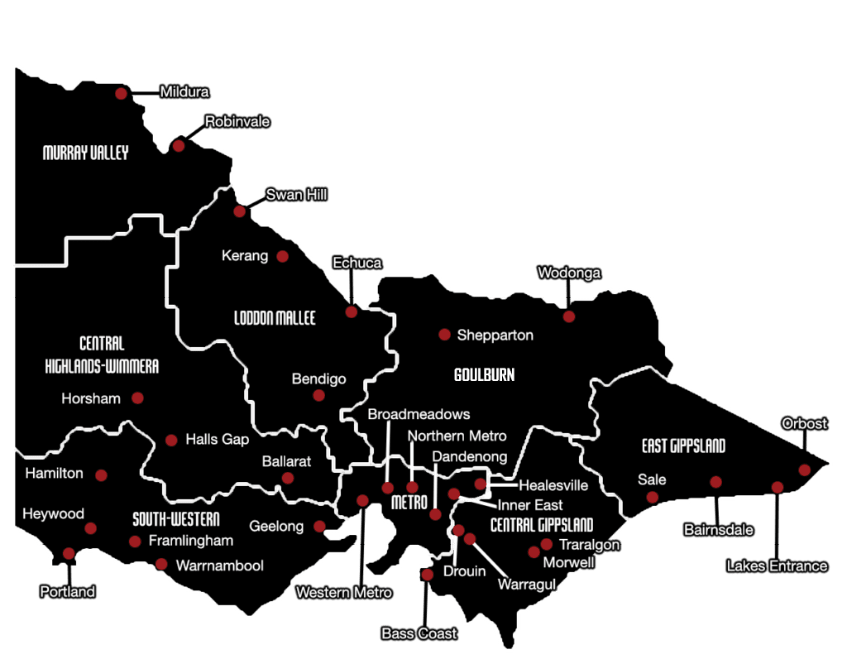
There are 8 LAECG regions, based on traditional networks, with several LAECG members (see map at the bottom of the page). More than one LAECG may be part of an engagement if there is the same Traditional Owner, but different LAECG localities.
Involvement in VSBA First Nations design engagements
Key tasks
- LAECGs represent First Nations people living off Country in a particular area (i.e. not Traditional Custodians) by:
- attending all engagement meetings and/ or participating in Yarning time
- contributing to the First Nations design recommendations VAEAI prepares based on discussions in engagement meetings
- signing off on how First Nations design recommendations will be implemented in VSBA projects
- giving the VSBA feedback on how to improve engagement with First Nations people on building projects.
- LAECGs may also participate in Regional Advisory Groups.
Leads First Nations design engagement on:
- no projects, but they attend all meetings.
- LAECGs represent First Nations people living off Country in a particular area (i.e. not Traditional Custodians) by:
Marrung Facilitators are VAEAI staff that work to implement their regional Marrung plan (read more about Marrung in the Strategic context section).
Involvement in VSBA First Nations design engagements
Key tasks
- Attend all engagement meetings and/ or participate in Yarning time.
- Support LAECGs to participate in engagement meetings (as LAECGs are volunteers).
- Contribute to the First Nations design recommendations VAEAI prepares based on discussions in engagement meetings.
- Give the VSBA feedback on how to improve engagement with First Nations people on building projects.
Leads First Nations design engagement on:
- no projects, but they attend all meetings.
Note: Marrung Facilitators do not facilitate any of the VSBA’s First Nations design engagement meetings.
In partnership with VAEAI, the Koorie Outcomes Division (KOD) leads the department’s strategies for Aboriginal early childhood and school education and training. This includes developing, coordinating, and evaluating department policy and service initiatives to improve outcomes for the Koorie community by:
- building partnerships with the Koorie community
- working across the department, and with other education stakeholders, to embed Aboriginal inclusion and perspectives in policies
- building strong government networks to develop and deliver Koorie programs and initiatives
- working closely with schools and the department's regional offices to develop and implement Koorie programs
- supporting the professional development of the department’s Koorie Education Workforce (KEW).
KOD is the VSBA's first point of contact for cultural protocol and knowledge queries.
Involvement in VSBA First Nations design engagements
Key tasks
- Provides high-level support to VSBA Communications on working with First Nations people.
- Manages the department's ongoing relationship with VAEAI, including coordinating the common funding agreement.
- Some Traditional Owners or LAECGs may wish KEW staff to support them in discussions.
- VSBA project officers should discuss KEW staff's participation in engagements with VSBA Communications and VAEAI prior to meeting.
Leads First Nations design engagement on:
- no projects – KOD and KEW staff don't typically participate in these meetings.
Early Learning Victoria (ELV) is establishing 50 government-owned and operated early learning and childcare centres (which are being built by the VSBA). The first 4 centres opened in 2025 and the next 14 will open in 2026. The Victorian Government has committed to opening all 50 centres by 2032.
Early Learning Victoria engage with Traditional Owners about the Aboriginal language naming of the centres at the same time as the VSBA's First Nations design engagements. Doing both together ensures the names relate to the First Nations design of the centres. It also reduces the burden on Traditional Owners.
Involvement in VSBA First Nations design engagements
Key tasks
- Engages with Traditional Owners about the naming of Early Learning Victoria centres.
Leads First Nations engagement on:
- Early Learning Victoria centre naming.
Note: Early Learning Victoria do not typically participate in VSBA First Nations design engagements, but may schedule a naming meeting around the same time.
Since 2023, the department's School and Campus Naming Policy has committed to using Aboriginal language names for new schools and campuses.
The School Provision and Establishment Division (SPED) engage with Traditional Owners about possible Aboriginal language names for new schools. As with ELV centres, this is done at the same time as the VSBA's First Nations design engagement. Doing both together ensures the proposed names relate to the First Nations design of the new schools. It also reduce the burden on Traditional Owners.
Involvement in VSBA First Nations design engagements
Key tasks
- SPED – or VSBA Communications on SPED's behalf – engages with Traditional Owners about the naming of new schools.
Leads First Nations engagement on:
- new school naming.
Note: SPED do not typically participate in VSBA First Nations design engagements, as VSBA Communications liaise with Traditional Owners about new school naming on their behalf.
The Kindergarten Expansion, Funding and Reform (KEFR) Division oversees the rollout of the Best Start, Best Life reforms, including the establishment of kindergartens on school sites (KOSS) to meet enrolment demand.
KEFR preference Aboriginal language names for KOSS at new schools in line with the School and Campus Naming Policy and the Naming 2027 KOSS Corporate Guidelines. Traditional Owners are asked about the Aboriginal language naming of KOSS at new schools at the same time as the VSBA's First Nations design engagements. Doing both together ensures the names relate to the First Nations design of the kinders. It also reduces the burden on Traditional Owners.
Involvement in VSBA First Nations design engagements
Key tasks
- Supports VSBA Communications to engage with Traditional Owners about the naming of KOSS at new schools.
Leads First Nations engagement on:
- KOSS naming.
Note: KEFR do not typically participate in VSBA First Nations design engagement meetings but are responsible for the KOSS naming policy and process.
Involvement in VSBA First Nations design engagements
Key tasks
- Projects architects help VSBA project officers respond to First Nations design recommendations from engagement meetings by developing a proposal.
- For each engagement meeting, architects prepare and present the project and progress on the First Nations design proposal. This presentation forms the basis of the discussion with Traditional Owners, VAEAI, LAECGs and Marrung Facilitators.
Leads First Nations design engagement on:
- no projects (nor do they facilitate meetings).
Map of LAECG regions

This image shows a map of Victoria with the 8 regions labelled. There are also cities/towns/areas labelled and indicated by red dots.
The regions and their labelled cities/towns/areas are (clockwise from top-left):
- Murray Valley
- Mildura
- Robinvale
- Loddon Mallee
- Swan Hill
- Kerang
- Echuca
- Bendigo
- Goulburn
- Shepparton
- Wodonga
- East Gippsland
- Orbost
- Lakes Entrance
- Bairnsdale
- Sale
- Central Gippsland
- Traralgon
- Morwell
- Warragul
- Drouin
- Bass Coast
- Metro
- Healesville
- Inner East
- Dandenong
- Northern Metro
- Broadmeadows
- Western Metro
- South-Western
- Geelong
- Warrnambool
- Framlingham
- Heywood
- Portland
- Hamilton
- Central Highlands – Wimmera
- Ballarat
- Halls Gap
- Horsham
- Murray Valley
- Download image
Updated