

- Published by:
- Victorian School Building Authority
- Date:
- 22 Jan 2026
Acknowledgement of Country
The Victorian School Building Authority acknowledges the Traditional Owners of Country throughout Australia and Victoria and their continuing connections to land, waters and community.
We pay our respects to Elders past and present and to all First Nations community members.
We recognise Traditional Owners across Victoria as the first educators of their Country and acknowledge that the schools and kinders we build are on sovereign Aboriginal land.
Our offices in East Melbourne are on the lands of the Wurundjeri People.

If you have any questions about this guide, please contact VSBA Communications via vsba.first.nations.engagement@education.vic.gov.au.
Introduction to First Nations engagement at the VSBA
Our commitment
Victorian education is richer and more truthful when it celebrates and respects the unique knowledge, history and experience of our First Nations Peoples.
We work with Traditional Owners, education partners and community members to embed local Aboriginal cultures in the design of our schools and kinders.
These artworks, stories and knowledge make culture and Country visible in education settings. They spark curiosity in our young people and communities.
They create welcoming spaces for First Nations students, staff and families. They teach us about Aboriginal cultures, our history and shared future.
Projects we engage on
We engage with First Nations stakeholders about the design of new schools and significant school upgrades. We also engage on early childhood projects, including kindergartens on school sites (whether a traditional or modular build) and Early Learning Victoria centres. Our First Nations stakeholders tell us how we should include their stories, knowledge, language or perspectives in the school or kinder's design.
This could be, but is not limited to:
- naming rooms in the local Aboriginal language
- employing artists to paint a mural or make a sculpture
- using colour palettes or shapes from Country
- planting a bush garden
- using specific animal footprints for wayfinding
- catching rainwater to use on the gardens
- building a yarning circle.
Our meetings include Traditional Owners as well as representatives from the Victorian Aboriginal Education Association Incorporated (VAEAI), Local Aboriginal Educational Consultative Group members (LAECGs) and Marrung Facilitators. Read more about these stakeholders in the Who we engage section.
Strategic context
Purpose
We co-designed this guide with the Victorian Aboriginal Education Association Incorporated (VAEAI) and the Department of Education's Koorie Outcomes Division to:
- have a clear and consistent way to engage with First Nations stakeholders on VSBA building projects
- communicate our process to stakeholders, including Traditional Owners and architects, in a transparent and accessible way
- provide practical, best practice guidance for VSBA project officers leading First Nations design engagements
- explain the strategic context of our First Nations design engagement work
- make it easier for First Nations people involved in VSBA engagements to give us feedback or make a complaint.
Scope
The guide:
- applies only to VSBA First Nations design engagements on school and kinder building projects
- aligns with commitments made in other departmental policies
- helps to apply VSBA policy for delivering building projects (for example, our Building Quality Standards Handbook and Project Management Framework)
- does not override existing government or departmental policies or legislation
- replaces previous stakeholder engagement approaches or forums with groups.
The guide does not:
- change how we name new schools, kindergartens on school sites or Early Learning Victoria centres
- offer guidance on cultural heritage management and Native Title processes (including state Recognition and Settlement Agreements).
For advice on new school naming, see the department's School and Campus Naming Policy, which commits to the use of Aboriginal language names.
For advice on Early Learning Victoria centre naming, see the Guidance note: Aboriginal language naming program (link to come).
Self-determination
Broadly, self-determination is the right for First Nations people to make decisions on matters that affect their lives and communities and be able to practice culture.
Working with First Nations people on the path to Treaty, truth-telling and self-determination is central to our work in government.
Relevant policies
Dhelk Wukang (2022-26)
Dhelk Wukang is the department’s fourth Aboriginal inclusion plan. It builds on the foundations of previous work while acknowledging that we can – and must – do more. We have a shared responsibility to create a culturally safe environment for Aboriginal people to work, feel valued and achieve success.
The plan commits us to strengthening Aboriginal inclusion, self-determination and cultural safety at all levels within the department. This includes the Victorian Public Service and Government Teaching Service. It also commits to a relationship of mutual respect and joint decision-making with Aboriginal people.
Dhelk Wukang outlines the proactive steps the department is taking to support tangible, positive structural change across our entire workforce – in school and corporate settings – to ensure every departmental workplace is safe for Aboriginal people.
Connection to VSBA First Nations design engagement
Dhelk Wukang commits the VSBA to engaging with First Nations people to embed Aboriginal culture in new schools and significant upgrades of existing schools. Early childhood is a newer portfolio for the VSBA, so the commitment also applies to new kinders and kinder upgrades.
We’ve translated the guidance of Dhelk Wukang into the Building Quality Standards Handbook (BQSH) and the Project Management Framework (PMF).
Marrung (2016-2026)
Marrung is the department's strategy to ensure that all Koorie Victorians achieve their learning aspirations. Students can do better if schools and kinders are more inclusive, responsive and respectful. If education settings celebrate First Nations cultures, it helps every Koorie person to succeed. Marrung identifies key actions to achieve its vision.
Marrung was developed in partnership with VAEAI and builds on previous strategies like Yalca (2001).
Connection to VSBA First Nations design engagement
One way the department will achieve the vision of Marrung is by providing a "positive climate for learning and development". This includes making schools and kinders more culturally inclusive. Embedding First Nations design at schools and kinders helps create inclusive and culturally welcoming places for First Nations kids to learn.
Strengthening Aboriginal Self-Determination in Education
This department report provides clear reform directions to strengthen self-determination in education. It was created after deep listening to over 3,000 First Nations people at more than 180 campfire conversations.
Connection to VSBA First Nations design engagement
The report suggests reviewing schools' physical environments as a 'practical first step' to making sure schools are welcoming and safe places. In our design engagements, Traditional Owners and other First Nations stakeholders tell us how we can create culturally safe and responsive learning spaces – this also supports self-determination.
VSBA commitment to customer service
Empowering schools, engaging communities and completing building projects all hinge on customer relationships. Our public commitment to great customer service sets minimum service standards and values and behaviours for our staff. It also provides a way for our stakeholders to give us feedback or make a complaint.
Connection to VSBA First Nations design engagement
First Nations Peoples and communities are one of our key customer groups and our work with them makes education settings more culturally safe and meaningful. We expect our staff to provide a consistently high standard of service throughout First Nations design engagements.
Child Safe Standards
Victoria has 11 Child Safe Standards which promote the safety of children. By law, organisations that provide services to children are required to meet the standards.
Child Safe Standard 1
Organisations establish a culturally safe environment in which the diverse and unique identities and experiences of Aboriginal children and young people are respected and valued.
Connection to VSBA First Nations design engagement
We are part of the department and must meet the Child Safe Standards. We help to create culturally safe environments for children at schools and kinders through our design engagements with Traditional Owners and other First Nations stakeholders.
Victorian Aboriginal Affairs Framework
The Victorian Aboriginal Affairs Framework 2018–2023 (VAAF) is the state's overarching strategic framework for working with Aboriginal Victorians, and other stakeholders, to deliver better outcomes. The framework also commits the government to advancing Aboriginal self-determination by transforming systems and structures. The VAAF includes 11 principles of self-determination:
- human rights
- cultural integrity
- commitment
- Aboriginal expertise
- partnership
- decision-making
- empowerment
- cultural safety
- investment
- equity
- accountability.
Connection to VSBA First Nations design engagement
As a government department, we are required to meet the commitments made in the VAAF. Our First Nations design engagements support self-determination by including First Nations people in decisions that shape the learning environments in schools and kinders.
Note: the framework was due to end in 2023 but has been extended to allow for consultation on next steps.
Acronyms and terminology
Note on our terminology for VSBA Delivery project officers
We call our cultural design consultations with Traditional Owners, Local Aboriginal Education Consultative Groups (LAECGs) and the Victorian Aboriginal Education Association Incorporated (VAEAI), First Nations design engagements.
First Nations is a collective term that refers to Aboriginal and Torres Strait Islander people who may or may not be Traditional Owners of the Country you're engaging on. Stakeholders who participate in our engagements include Traditional Owners and other First Nations people living off Country.
Avoid referring to 'Indigenous engagement', 'Culturally and Linguistically Diverse (CALD) engagement' and 'cultural engagement'. While Indigenous is commonly used across government, it is not considered respectful by some First Nations people. CALD or cultural engagements are too general to describe the engagement we do with First Nations people.
The term Koorie refers to Victorian Aboriginal people. At the department and the Victorian Aboriginal Education Association Incorporated (VAEAI), this term is often used inclusively to refer to Aboriginal and Torres Strait Islander people living, studying and working in Victoria. As the word may not be familiar or relevant for all Aboriginal and Torres Strait Islander people, use First Nations when talking broadly. When speaking specifically, it's best practice to use the name of the Traditional Owner group.
It is also important to be respectful of how individuals and communities refer to themselves and use this understanding to guide the language you use in engagements.
| Acronyms/terms | Meaning |
|---|---|
| VSBA | Victorian School Building Authority |
| DE or the department | The Department of Education (Victoria) |
| SPED | School Provision and Establishment Division, Department of Education |
| ELV | Early Learning Victoria |
| KEFR | Kindergarten Expansion, Funding and Reform Division, Department of Education |
| KOD | Koorie Outcomes Division, Department of Education |
| KEW | Koorie Education Workforce, Department of Education |
| KEC | Koorie Education Coordinator |
| KESO | Koorie Engagement Support Officer |
| KEM | Koorie Education Manager |
| PO | VSBA Project Officer |
| PM | Project Manager |
| RAG | Regional Advisory Group |
| BQSH | Building Quality and Standards Handbook |
| PMF | Project Management Framework |
| PDC | Principal Design Consultant |
| VAEAI | Victorian Aboriginal Education Association Incorporated |
| Marrung Facilitator | Regional VAEAI staff member focused on implementing their regional Marrung Aboriginal Plan. They support LAECGs in VSBA cultural design engagements. |
| LAECG | Local Aboriginal Education Consultative Group; LAECG members (or LAECGs) are volunteers that represent First Nations people living off Country in VSBA cultural design engagements. |
| RAP | Registered Aboriginal Party |
| Traditional Owner or Traditional Custodian | Traditional Owners are the custodians of their ancestral lands and may, or may not, be formally recognised under the Victorian Aboriginal Heritage Act. Traditional Owner is interchangeable with Traditional Custodian. Traditional Owner is used throughout this guide as it is a commonly known and accepted term. Traditional Custodian is preferred by some First Nations people. |
| Ceremony | This term encompasses several ceremonial activities practiced by Traditional Owners including, for example, a Welcome to Country. |
| ICIP | Indigenous Cultural and Intellectual Property |
| VACL | Victorian Aboriginal Corporation for Languages |
| Yarning time | Time for First Nations attendees to privately discuss their thoughts before presenting their recommendations in engagement meetings. |
Who we engage
There are a range of stakeholders involved in the VSBA's First Nations design engagements.
Typically, representatives from the following groups attend engagement meetings:
- VSBA Communications (primarily for new schools and their co-located kinders)
- VSBA Delivery project officers
- Traditional Owners
- Local Aboriginal Education Consultative Group members (LAECGs)
- Victorian Aboriginal Education Association Incorporated (VAEAI) project officers and Marrung Facilitators
- project architects.
If requested by Traditional Owners or LAECGs, staff from the department's Koorie Education Workforce or Koorie Outcomes Division may also attend.
Staff from Early Learning Victoria (ELV) and the department's School Provision and Establishment Division may attend if the project involves naming an ELV centre or new school.
Roles and responsibilities
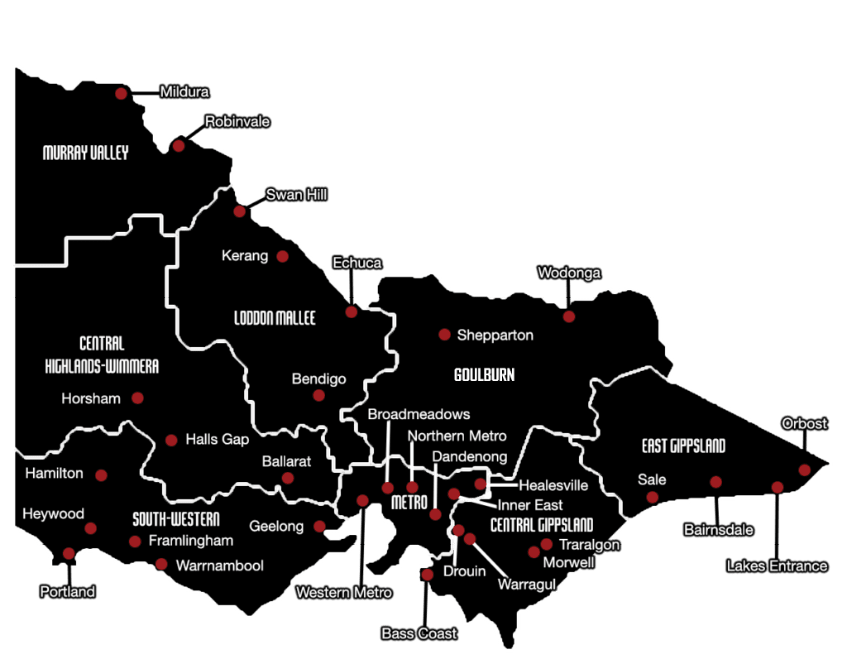
Map of LAECG regions

Our engagement process
Our approach
We are guided by First Nations people about how to include their perspectives in schools and kinders.
We believe that good engagement is based on:
- supporting self-determination
- respect for First Nations perspectives, priorities and intellectual property
- timely, useful and culturally safe communication with the right people
- a shared understanding of when the engagement will happen and what it is about
- supporting relationships between Traditional Owners and the school, kinder and community
- meeting our commitments
- learning from previous consultations and building capability in our staff.
Our engagement meetings typically include Traditional Owners, LAECGs, VAEAI staff, Marrung Facilitators, VSBA Delivery project officers and the project architects. School principals or kinder directors may attend engagement meetings, if Traditional Owners are supportive. VSBA Communications advisers lead engagement meetings for new schools.
How the meetings run
VSBA Delivery project officers facilitate the meetings, unless Traditional Owners request otherwise. Meetings usually run for one hour and follow this format:
- Acknowledgement of Country
- introductions and meeting purpose
- presentation on the project and First Nations design proposal
- comments and questions
- private Yarning time for First Nations attendees
- feedback from First Nations attendees
- next steps.
Note: VSBA Delivery project officers facilitate all engagement meetings, except for new schools, which are facilitated by VSBA Communications advisers.
Yarning time
Time is set aside in design engagement meetings for First Nations attendees to privately discuss their thoughts before presenting their recommendations. This time is not always used but should always be offered, even if meeting on Country.
Before Yarning time begins, project team representatives should leave the room when meeting in person, or log out when meeting online. Typically Yarning time takes 10-15 minutes. Some Traditional Owners may request longer.
Engagement steps
The table below outlines our First Nations design engagement process at typical school or kinder project milestones.
| Project milestone | First Nations engagement process |
|---|---|
| State budget (or other announcement) |
|
| Architect is appointed |
|
| Schematic design (or as early as possible) |
|
| Design development |
|
| Builder appointment and/ or construction |
|
| Practical completion |
|
| School or kinder opening |
|
Engagement costs
- There is no fee for consulting with VAEAI and LAECGs.
- Traditional Owners, including RAPs, offer different services and determine their own engagement fees.
- Costs should be discussed with Traditional Owners at the start of your engagement.
- Common costs are for engagement meetings, artist EOIs and Aboriginal language requests (separate to the cost of physical cultural design elements, including artwork).
For advice on procuring artworks that protect the cultural and intellectual property of the artist, VSBA project officers should contact the department's Koorie Outcomes Division at marrung@education.vic.gov.au.
Engaging and working effectively
Cultural safety
- Cultural safety is a shared responsibility; you can create culturally safe environments by leading with awareness and respect.
- In a culturally safe environment, First Nations people:
- are respected and their perspectives are valued
- feel comfortable being themselves and expressing their culture and beliefs
- do not have their identity and culture challenged or denied.
- Culturally unsafe environments have a direct effect on the level of engagement on our building projects and the ongoing relationships between First Nations stakeholders and the VSBA.
Diversity of Victoria's First Peoples
There are 44 language groups and 12 Registered Aboriginal Parties (RAPs) (formally recognised Traditional Owners) that cover approximately 77.5% of Victoria. There are Traditional Owner groups across all of Victoria, even if they are not yet formally recognised.
Aboriginal identity is about connection to Country, community and family. Each Traditional Owner group has different cultures, languages, processes and aspirations. Learn more by checking out the Melbourne Museum's virtual tour of the First Peoples exhibition at Bunjilaka Aboriginal Cultural Centre.
It is offensive to question or suggest someone is only part Aboriginal or link Aboriginality to skin tone, particularly given the history of how Aboriginal people were researched and classified according to ‘blood quantum’.
How language fits into First Nations design engagements
- Recommendations about language are often made during our engagements.
- The VSBA should lead language requests with Traditional Owners when it relates to the infrastructure (e.g. room naming, wayfinding, Acknowledgements of Country, signage about cultural narratives etc.).
- Language requests normally need to be submitted to Traditional Owners in writing. VSBA project officers should ask Traditional Owners about their language request process during engagement meetings.
- You need permission from Traditional Owners to use their language.
- Many Traditional Owners are working to revitalise their languages which have been impacted by colonisation, the Stolen Generations and other assimilation policies.
- Traditional Owner groups have their own language request processes. This often includes linguistics research and consultation with Elders, community, linguists and Koorie peak bodies.
- You should not suggest language to use, even if you have found it in an Aboriginal language dictionary or the 50 Words Project.
- Traditional Owners do not provide a 'translation service'. They will work with you to understand the language request and what is relevant for the place, purpose and people. Sometimes a concept, rather than a single word, may be more appropriate.
- Use of language requires permission from Traditional Owners and usually has an associated fee and license.
- The VSBA is not responsible for new school and Early Learning Victoria (ELV) naming, although we coordinate with relevant areas to make sure the engagements run parallel. This helps to align the First Nations design with the name and engages Traditional Owners for the same project at the same time.
- New school and ELV centre naming engagements are overseen by the School Provision and Establishing Division (SPED) and ELV, respectively. ELV has developed a guidance note about their Aboriginal language naming program (link to come). Note: to simplify engagement with Traditional Owners about new schools and their co-located kinders, VSBA Communications often liaise with Traditional Owners on SPED's behalf.
- Naming of kindergartens on school sites at existing schools is overseen by the Kindergarten Expansion, Funding and Reform Division (KEFR), with support from VSBA Delivery where applicable.
- Building naming must comply with SPED's School and campus naming policy. Discuss how this might impact your project with VSBA Communications.
Why language is important
- Language is important to First Nations people because it is a way to express their identity, be proud of where they come from and who they are.
- If a person knows a word in their language, they are maintaining a link that has lasted thousands of years. They are keeping words alive that have been used by their ancestors – language is an ancestral right.
- Language is a part of culture, and knowledge about culture is a means of empowering people.
- Language contributes to the wellbeing of communities, strengthens ties between Elders and young people and improves education.
Source: Victorian Aboriginal Corporation for Languages (you can also find a map of Aboriginal language groups in Victoria at this link).
Indigenous Cultural and Intellectual Property (ICIP)
This section was prepared using guidance from the Queensland Department of Education. This is a good starting place to have conversations in VSBA First Nations design engagements.
Source: Indigenous Cultural and Intellectual Property Protocol for the teaching of Aboriginal languages and Torres Strait Islander languages in Queensland State Schools is licensed under CC BY 4.0.
Victoria is committed to finding better ways to engage with, and use, First Nations knowledge. We are doing this in ways that uplift and recognise the legacy, sovereignty and rights of First Nations peoples.
It is not okay to misappropriate culture by copying artworks from digital sources and using these in your work. Nor should anyone hear a language word for "peaceful" and use this to name a place. All cultural knowledge is specific to place (Country) and people.
There are few documented guides about ICIP, so always talk with First Nations stakeholders to understand their perspectives and processes.
ICIP acknowledges the value in the cultural knowledge and expression of Aboriginal and Torres Strait Islander peoples
- ICIP protocols support the rights of Aboriginal and Torres Strait Islander people to control and protect their languages, knowledge and cultural expression.
- ICIP rights are enshrined in international laws – Article 31 of the United Nations Declaration on the Rights of Indigenous Peoples states that Indigenous peoples have the right to maintain control of their cultural heritage and traditional knowledge, as well as the intellectual property of that cultural heritage and traditional knowledge.
Traditional knowledge does not fit neatly into the Australian IP system. Under that, IP rights belong to a particular person or legal entity for a specified period, rather than to a group of people collectively forever.
What ICIP looks like in practice
- First Nations people decide what to provide and consent for use in the project. They have the right to authorise or refuse use.
- First Nations peoples define the scope and how the ICIP is used.
- If use is authorised or consent given, First Nations People/s are recognised as the owners.
- VSBA project officers should be guided by Traditional Owners. They should discuss ICIP early in engagement. This allows First Nations people to fully consult, consent and recommend changes.
- We seek approval on a case-by-case basis for the use of language and cultural knowledge unless stated otherwise.
- We do not assume cultural knowledge or language provided on one project is appropriate to use on another.
10 principles for working with ICIP
| Principle | Practice |
|---|---|
| Respect | We will respect the rights of Aboriginal and Torres Strait Islander Peoples to maintain, control, protect and develop their ICIP. |
| Self-determination | Aboriginal and Torres Strait Islander Peoples have a right to self-determination in relation to their ICIP and must be empowered and supported to make decisions about the use of their ICIP. |
| Collaboration and consent | Aboriginal and Torres Strait Islander Peoples must give their prior, fully informed consent for any use of their ICIP. Consent must come from individuals who share specific ICIP as well as at a family or community level. Consent should be recorded in writing as much as possible, using agreements, contracts, forms, or other instruments. |
| Interpretation | Aboriginal and Torres Strait Islander Peoples are the primary guardians and interpreters of their ICIP and have the right to decide how their ICIP is presented. Their perspectives and understandings must be prioritised to ensure portrayal of Aboriginal languages and cultures and Torres Strait Islander languages and cultures are accurate and empowering. |
| Cultural integrity | Aboriginal and Torres Strait Islander Peoples have the right to guard the cultural integrity of their ICIP. |
| Secrecy and privacy | Aboriginal and Torres Strait Islander Peoples have the right to keep secret their sacred and ritual knowledge in accordance with their customary law. The privacy of Aboriginal and Torres Strait Islander individuals will also be respected. |
| Benefit sharing | Aboriginal and Torres Strait Islander Peoples have the right to share in any benefits, commercial or otherwise, that come from the use of their ICIP. |
| Attribution | Aboriginal and Torres Strait Islander Peoples be given full attribution for sharing their ICIP. This includes individual language and culture specialists. |
| Cultural maintenance | Aboriginal and Torres Strait Islander cultures are dynamic. The long-term management of ICIP in school infrastructure projects should respect the continuing customary use, development, exchange and transmission of ICIP so that it is properly maintained and protected for the use and benefit of future generations of Aboriginal and Torres Strait Islander Peoples. |
| Recognition and protection | The department will use Australian laws, as well as contracts, protocols and policies to recognise and protect ICIP rights of Aboriginal and Torres Strait Islander Peoples. |
Engaging artists for First Nations design engagements
Traditional Owners usually have an expression of interest (EOI) process for engaging their network of artists. They may also prefer to engage an artist from their community, rather than the broader First Nations community. VSBA project officers should discuss the artist EOI process with Traditional Owners on a case-by-case basis for school and kinder building projects.
Typically the first step is to prepare an artist brief with the scope and budget for the work. Once the brief is shared, EOIs will be evaluated, often by Traditional Owners and the VSBA. Project officers should expect to have an ICIP discussion with the artist, which will be formalised through a written agreement and payment.
Further guidance for VSBA project officers
What you can do
Refresh your training
The best thing you can do is expand your understanding of Aboriginal and Torres Strait Islander history, culture, traditions, values and experiences. This will help you to work in a culturally informed way.
Get in touch with VSBA Communications to find out about the training opportunities available.
Engage as early as you can
- Engaging early improves design outcomes by giving you time to build relationships and respond to recommendations.
- The earlier you engage, the more flexibility you have.
- Avoid placing restrictions on the engagement scope. Often more can be done than you think, so take the time to work through the recommendations and how they can be included between meetings.
- Common recommendations are about the cultural narrative across the site. This might be represented through built forms, site orientation, materials and finishes, landscapes, planting, colour palettes, artwork and wayfinding.
- While the VSBA cannot implement curriculum at the school or kinder, if we receive a recommendation about this, we should help Traditional Owners and LAECGs establish relationships with relevant staff.
- The budget for First Nations design is guided by the recommendations received through engagement. Some elements being delivered will become cultural design features. Although the budget is not fixed, you should be clear of any limitations.
Fostering cultural safety
- While questions and curiosity are okay, to create a culturally safe space you should have a basic understanding of:
- the VSBA’s process for First Nations design engagements
- the Country you’re meeting on and a bit about the Traditional Owners (e.g. aspirations and nearby significant sites)
- what Country is (land, water and sky) and what being on Country means (you are always on Aboriginal land in Victoria, whether in the city or rural areas)
- common and acceptable terminology (Traditional Owner/Custodian, RAP, First Nations, Aboriginal and Torres Strait Islander, Koorie, Indigenous, Aunty/Uncle, etc.)
- your responsibility to protect Aboriginal cultural heritage in Victoria (reach out to VSBA Property to learn more about this and state or federal Native Title)
- the difference between an Acknowledgement of Country and Welcome to Country
- how to give a meaningful Acknowledgement of Country
- Aboriginal perspectives on our history
- self-determination and how we can support this through our work
- important dates/weeks for First Nations people.
- Respect First Nations diversity
- Don't assume something from another of your engagements is relevant, even if you are working with the same Traditional Owners.
- The way you work with Traditional Owners will differ between groups and evolve along the way.
- Traditional Owner groups have different languages. There is not a common Victorian Aboriginal language.
- Create space for First Nations people to tell their story if they choose to and sit comfortably in silence. Really listen and read cues.
- Do not talk over people and, especially when online, make sure you are leaving space for people to finish sharing.
- Learn more by visiting the Koorie Heritage Trust or completing training offered by the department or VSBA.
- Be transparent
- The relationship between First Nations Peoples and government in Australia has been one of power imbalance. A lack of clarity can break down trust.
- Be clear about what is in scope for the engagement and what is not, timeframes, whether a project has funding for construction or only planning, potential impacts of the tender outcome and budget (etc.).
- If you receive a recommendation about something you can't implement (e.g. curriculum), make this clear and support connections to relevant parties where possible.
- Be aware of how recent our shared history is and the impact that has on First Nations people today
- The Stolen Generations, massacres, past policies to remove First Nations Peoples from their Country, and attempts to ‘ban’ cultural practices and language impacts every generation. Intergenerational trauma is current and relevant. Be mindful of this, especially when working with language and place.
- Follow cultural protocols
- Ask Traditional Owners where they would like to meet.
- Know the Country you are on and come prepared to lead with an Acknowledgement of Country (make sure not to say you are "welcoming" attendees).
- Do not ask Traditional Owners or First Nations representatives to do the Acknowledgement of Country. However, if you are organising an on Country meeting, ask the Traditional Owners ahead of time if they would like to do a Welcome to Country.
- Provide adequate time for introductions.
- Always include Yarning time on meeting agendas so First Nations people (Traditional Owners, LAECGs, Marrung Facilitators and sometimes VAEAI) can privately discuss their thoughts before presenting their recommendations.
- Confirm with VAEAI about who should be included in meetings, especially if you want to include someone outside of the usual stakeholder groups.
- Don't assume honorifics (e.g. Aunty or Uncle) but you must use them if someone has one. If you are unsure – ask!
- Balance respect for the allotted time without rushing conversations. Check in with attendees if you need to.
- Confirm your understanding of what you've heard by using reflective language and summarising actions or next steps.
- Always have approval to use language and cultural knowledge in a project.
- Seek approval if you need to change something previously agreed
- Sometimes design features need to be changed due to, for example, a poor tender outcome.
- As much as you can, communicate this possibility in advance.
- Any changes to how recommendations will be implemented must be agreed with Traditional Owners and other First Nations stakeholders.
Delivery project officer checklist for engagements
Resources
Document templates
We have various templates on our intranet for VSBA project officers to use when preparing to engage.
- Project officer checklist (downloadable version from this guide)
- Project intake form
- Invitation to Traditional Owners
- Confidentiality agreement
- Calendar invitation
- Acknowledgement of Country wording
- Meeting agenda
- Meeting minutes
- Meeting 1 slide deck
- Meeting 2 slide deck
- Meeting 3 slide deck
- Meeting 4 slide deck
- Recommendations and endorsement form
- Thankyou letter
Some links on this page are only available to VSBA and Department of Education staff. Contact VSBA Communications if you are unable to access any documents or intranet sites.
Links to learn more
Tell us what you think
We want to know if:
- our engagement was unsatisfactory or culturally unsafe
- we did not meet our engagement or customer service standards
- you were denied respect, dignity or privacy
- you have an integrity or ethical concern about our organisation
- you have suggestions for how we can engage better.
You can give us feedback or make a complaint.
You are also welcome to approach your VSBA and VAEAI contacts directly to raise any concerns.
Contact VSBA Communications about the guide, or for support with an engagement.
Document copyright
© State of Victoria (Department of Education) 2025
The copyright in this document is owned by the State of Victoria (Department of Education) or, in the case of some materials, by third parties (third party materials). No part may be reproduced by any process except in accordance with the provisions of the Copyright Act 1968, the National Education Access Licence for Schools (NEALS) (see below) or with permission.
An educational institution situated in Australia which is not conducted for profit, or a body responsible for administering such an institution may copy and communicate the materials, other than third party materials, for the educational purposes of the institution.
Authorised by the Department of Education, 2 Treasury Place, East Melbourne, Victoria, 3002